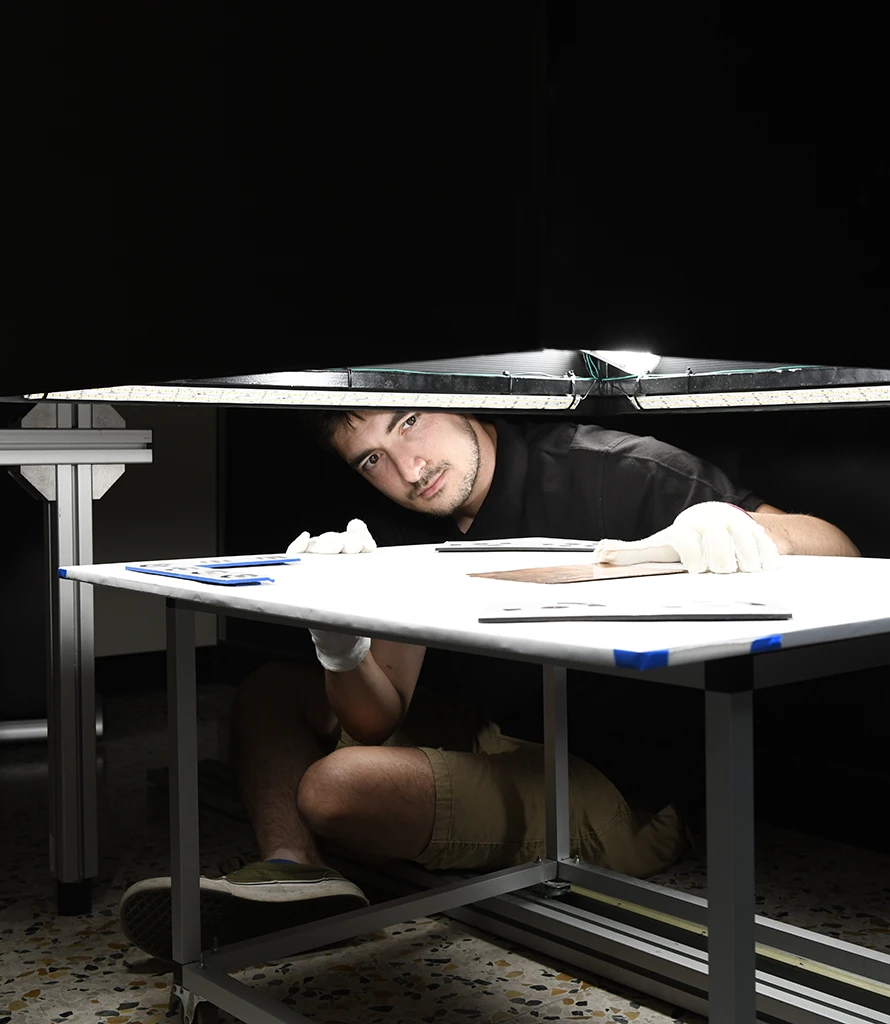
The RTI scanner is a system designed toacquire Reflectance Transformation Imaging (RTI)images with gigapixel quality, combining the advantages of ultra-high resolution photography with advanced surface analysis of artworks. RTI technology makes it possible to detect micro-details, roughness and surface variations that are difficult to perceive with traditional acquisition techniques, offering fundamental information for the study, monitoring and enhancement of cultural heritage.
The system is supported by a structure developed from operational experience in the field, designed to adapt to museum spaces and storage facilities. This makes it possible to work on paintings and objects in different positions, minimizing the movement of works and reducing conservation risks and logistical complexities.
The acquired images are then processed by software to generate patterns of light interaction on the surface, thus enabling virtual, interactive re-lighting from any direction.

– Features
Reflectance Transformation Imaging uses variations in illumination to analyze the surface morphology of artworks.
The scanner enables RTI acquisitions with gigapixel quality, combining surface analysis with a high level of image detail.
The system uses lighting sequences from different directions to reconstruct the light response of the surface of the work being processed.
The scanner is mounted on a stand that fits in museum spaces and storage rooms, allowing acquisitions on paintings and objects in different positions.
The support structure allows operation in physically constrained environments, such as exhibition halls and storage facilities, without requiring overly invasive configurations.
The acquired images are processed in order to generate models of the interaction between light and surface, which are useful for having precise and detailed visual and scientific analysis.
The RTI system can be integrated into broader digitization pipelines, flanking other 2D, 3D or ultra-high resolution acquisition techniques.
RTI technology makes readable micro-details, roughness, engravings and surface traces that are difficult to perceive with traditional acquisition techniques, enhancing the material and formal understanding of the work.
The ability to virtually re-illuminate the work from any direction provides advanced tools for scientific, art-historical and comparative analysis, expanding the possibilities for study and interpretation.
The high sensitivity to surface changes makes the RTI scanner particularly effective for comparison over time, supporting conservative monitoring activities and early detection of alterations.
The system makes it possible to operate directly at the place where the work is exhibited or stored, thereby reducing handling, manipulation, and logistical and conservation risks associated with moving assets.
RTI acquisitions can be integrated into digital viewers and platforms, offering interactive modes of enjoyment and effective tools for communication and enhancement of the relevant cultural heritage.
The RTI technique allows the acquisition of relevant information without direct contact with the surface of the work, making it particularly suitable for fragile, sensitive materials or those in delicate conservation conditions.
– Contacts
Phone
Registered office
41126 Modena (MO)