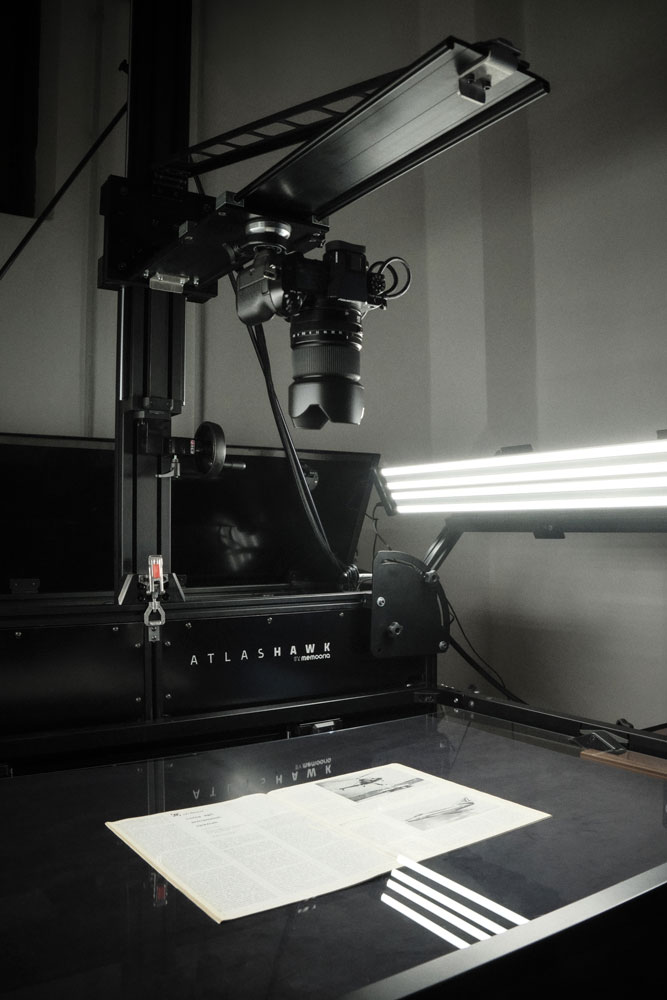
Atlas Hawk

Robotic planetary scanner for conservative digitization of volumes

Atlas Hawk was born from a concrete need: digitizing bound books and documents ensuring high image quality, productivity and protection of the original. In real acquisition contexts, in fact, the variability of volumes and the delicacy of materials make aspects such as alignment to glass, flatness, and pressure exerted during the shot critical.

To address these constraints, Memooria designed a robotic planetary system in which two motorized planes, adjustable and controlled by sensors, support the volume and control its approach to the glass with a uniform pressure. The operating flow is optimized to reduce manual intervention: the operator confirms alignment, the system automatically sets acquisition conditions, and the camera takes the shot. The result is a safer process, repeatable and efficient, also suitable for large-scale projects.

Copia di GPC PNRR Collezione Caproni TN 03

– Features

Technical aspects of Atlas Hawk hardware

High resolution

High-definition capture is used to make details, textures, and micro-marks readable, maintaining consistent quality throughout the entire volume and between different sessions
# 0

Motorized tops

They were born to handle volumes with different thicknesses and weights on the two sides, so the system accompanies the book and supports its opening in a controlled manner during acquisition.
# 0

Tempered glass

It stabilizes the page and reduces deformation during shooting, while maintaining a transparent and stable surface designed to work continuously and safely.
# 0

Integrated software

Software-based control allows a job to be set up and maintained over time, so variables between different sessions are reduced and the process remains repeatable.
# 0

Exposure management

Consistent images require controlling power and exposure time to light, managing the lighting and bringing it to the correct level only during shooting.
# 0

Optimized workflow

The operating sequence is built for daily use, with alignment, confirmation, snap, and spacing, so the flow remains smooth and scanning is not interrupted.
# 0

Adaptable configurations

Because not all books require the same approach, Atlas Hawk provides selectable pressure levels and adjustments, so the process adapts to brittleness, thicknesses and openings.
# 0

Do you need a comparison?

Write or call us for more information.
– Architecture

The benefits of digitization with Atlas Hawk

Precision Mechanics

In the design phase, a stable and repeatable system suitable for prolonged sessions was needed. Therefore, the mechanics manage the movements of the tops and glass in a controlled manner, reducing vibration and variations.

Intuitive interface

During acquisition, it is important to reduce unnecessary steps, collect essential actions, and make work control immediate, so the operator can focus on proper volume and pace management.

Advanced sensors

Pressure on the glass must always be controlled, especially on delicate materials, so sensors dynamically adjust the planes, maintaining uniform and repeatable contact between the page and the glass.

Controlled lighting

To have consistent images you need to control power and exposure time to the light, so the system manages the lighting by bringing it to the correct level only during shooting and reducing it immediately afterwards.

Modular system

Atlas Hawk is designed to work on different materials without changing approach, so adjustments and settings allow continuity in the process and consistency in the results obtained.

Efficient operation

Automation was created to reduce repetitive gestures and operational variables, so alignment, snapping, and spacing help maintain a smooth flow, especially when volumes to be captured increase.

– Contacts

To learn more about tools, flows and use cases, contact us.

Registered office

Corso Camillo Benso Conte di Cavour, 56

41126 Modena (MO)

Do you have a specific request? Fill out the form

Memooria bg infinito