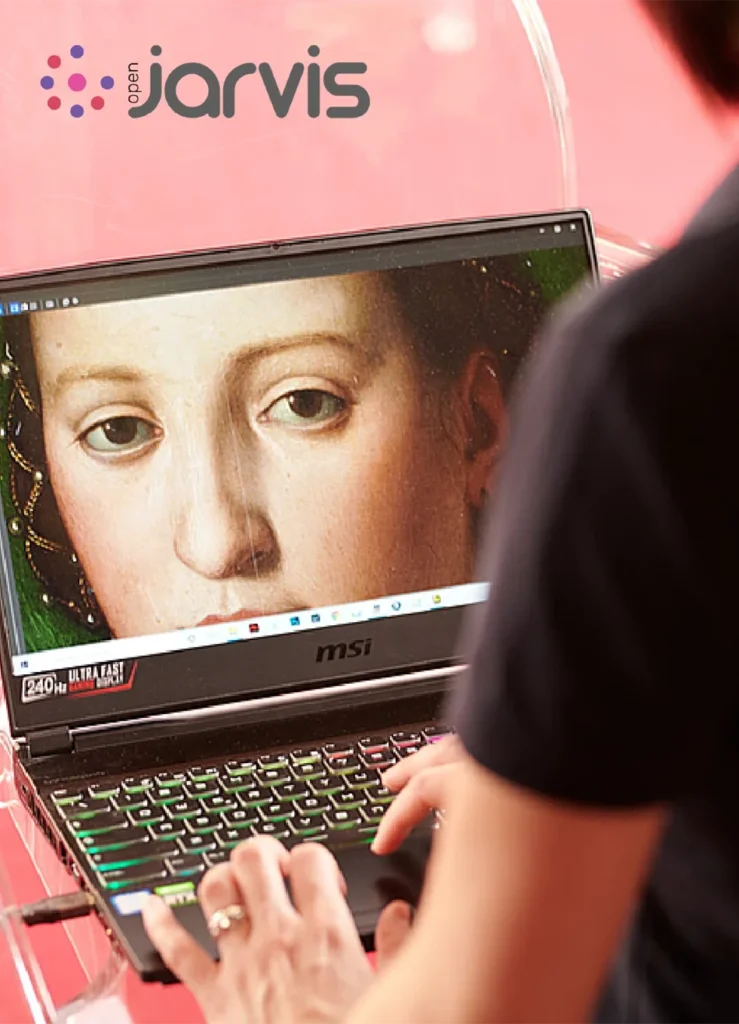
OpenJarvis

Open source platform for managing, enhancing and publishing large digital assets

OpenJarvis was created to address a recurring need in digitization projects: Managing large amounts of images and metadata, often in high and very high resolution, while maintaining control, consistency and accessibility over time. For archives, libraries and cultural institutions, file preservation alone is not enough: it is necessary to ensure their searchability, interoperability and publishability, without compromising quality and traceability.

For this Memooria has developed an open source Digital Asset Manager that allows archives to be explored and managed through a Web interface or WebAPI REST, integrating IIIF viewers and third-party systems. From a technical point of view, OpenJarvis adopts a’cloud-native microservices architecture., designed as a scalable infrastructure, capable of ensuring efficiency and high performance even on large collections, exposing data and metadata according to open standards.

OpenJarvis software per digitalizzazione beni culturali Memooria

– Features

Technical aspects of OpenJarvis software

IIIF compliant

Designed to create public and interoperable catalogs, it allows easy integration of viewers and external components without building ad hoc solutions.
# 0

Big pictures and volumes

Storage management is designed to support large images while maintaining smooth, high-resolution browsing.

# 0

WebAPI REST

Data and metadata can be managed throughout their lifecycle, so integrations and automations do not depend only on the GUI.
# 0

Advanced UI

The interface allows archives to be explored and managed in an orderly manner, making the experience more uniform even in articulated operational contexts.
# 0

Security and access control

Every request to images and data goes through a gateway that authenticates and authorizes access, with the ability to apply visible and non-visible watermarks.
# 0

Massive import and export

Supports massive import and export, both with native paths and with standard formats such as METS. Processes can be managed via UI or via API.
# 0

Scan lines

It can be integrated into on-site digitization lines, so the operator verifies consistency between images and metadata while maintaining continuity in the workflow.
# 0

Request more information

Call, email or book an appointment.

– Architecture

The benefits of OpenJarvis

Microservices

It is structured as a cloud-native microservices cluster for advanced and scalable functions, with a gateway that protects public endpoints and applies access and control policies centrally.

Cloud native and vendor independent

The architecture is designed for modern cloud environments without constraints to a single provider, a choice that allows the platform to be more sustainable over time and adaptable to different usage contexts.

Flexible and secure storage

Archival storage maintains permanent copies of files and supports recovery in case of accidental changes or deletions, protecting the continuity of digital assets even as volumes grow.

Extensibility and integration

It is designed to integrate with third-party platforms and to be extended with new features, leveraging the compositional paradigm of microservices, making evolutions and customizations easier and more sustainable.

Monitoring and disaster recovery

The architecture includes observability tools that monitor consumption, errors, and access, linked to alerting mechanisms that report anomalies and threshold exceedances, so the status is always verifiable.

Scalability and performance

With scalability, resources grow or shrink in a controlled manner while maintaining adequate performance. In addition, it is possible to work on very large collections without sacrificing consultation.

– Contacts

To learn more about tools, flows and use cases, contact us.

Registered office

Corso Camillo Benso Conte di Cavour, 56

41126 Modena (MO)

Do you have a specific request? Fill out the form

Memooria bg infinito